Red Light Therapy for Pain in Perth: Can Full-Body Photobiomodulation Help?

Persistent muscle and joint discomfort can affect everything from exercise and sport to sleep, work and everyday movement. As people look for non-invasive ways to support recovery and wellbeing, red light therapy: also known as photobiomodulation (PBM) - is receiving increasing scientific attention.
But can red and near-infrared light actually help with pain?
Research into photobiomodulation is growing, with studies investigating its effects on pain, inflammation, muscle recovery and cellular function. While it is not a replacement for appropriate medical assessment or treatment, the evidence suggests PBM may have a useful supportive role for some types of pain and recovery.
At Lumora Core in Applecross, Perth, we offer full-body photobiomodulation using the NovoTHOR whole-body red and near-infrared light therapy system.
What is photobiomodulation?
Photobiomodulation uses specific wavelengths of red and near-infrared light delivered to the body at controlled intensities and doses.
Unlike ultraviolet light, photobiomodulation does not work by heating or damaging tissue. Instead, red and near-infrared wavelengths interact with light-sensitive processes within cells.
One proposed mechanism involves the mitochondria — the structures responsible for producing much of the energy used by our cells. PBM has been investigated for its potential effects on cellular energy production, oxidative stress, circulation and inflammatory signalling.
These biological effects are among the reasons researchers are studying photobiomodulation in areas including pain, exercise recovery and musculoskeletal health.
What does the research say about red light therapy and pain in Perth?
The evidence is promising, but it is important not to oversimplify it.
A 2026 systematic review examined 14 randomised clinical trials investigating photobiomodulation in adults with chronic pain conditions. These included musculoskeletal pain, fibromyalgia, neuropathic pain and orofacial pain.
Most of the included trials reported reductions in pain, with particularly encouraging findings in some fibromyalgia and neuropathy studies. Some studies also reported improvements in function and quality of life.
However, the researchers highlighted an important limitation: PBM studies use different wavelengths, doses, treatment schedules and devices. This makes it difficult to establish one treatment protocol that applies to every condition.
In other words, photobiomodulation is an increasingly researched approach to pain management, but it should not be presented as a cure or guaranteed treatment.
How might red and near-infrared light influence pain?
Pain is complex. It can involve inflammation, tissue injury, nerves, muscles, joints and the way pain signals are processed by the nervous system.
Research suggests photobiomodulation may interact with several of these pathways.
Laboratory and clinical research has investigated PBM's influence on inflammatory signalling, oxidative stress and cellular metabolism. Other research suggests that light exposure may affect peripheral nerve activity and mechanisms involved in pain signalling.
These effects may help explain why PBM has been studied in a wide range of painful conditions.
Importantly, however, the biological response depends on factors such as wavelength, dose, treatment duration and the tissue being treated. More light is not necessarily better.
What about arthritis and musculoskeletal pain?
Musculoskeletal conditions are one of the major areas of PBM research.
For example, a 2024 systematic review and meta-analysis examined photobiomodulation for people with knee osteoarthritis, assessing its effects on pain and disability compared with placebo.
PBM has also been investigated in areas including neck and shoulder pain, soft-tissue injuries and other musculoskeletal conditions.
Results vary between studies, which is why photobiomodulation is best considered a potential complementary approach rather than a substitute for diagnosis, physiotherapy, exercise rehabilitation or medical treatment where these are required.
Why full-body photobiomodulation?
Many red light therapy devices treat a relatively small area of the body.
Whole-body photobiomodulation is different.
Instead of directing light at one small region, a whole-body system exposes a much larger surface area to red and near-infrared wavelengths simultaneously.
This approach is now being studied scientifically.
One randomised clinical trial investigated whole-body photobiomodulation in people with fibromyalgia using a NovoTHOR system. Participants receiving whole-body PBM showed improvements in several measures, including pain and quality-of-life outcomes, compared with placebo.
These results are encouraging, although further research is needed to understand which conditions and treatment protocols are most likely to benefit.
The NovoTHOR system
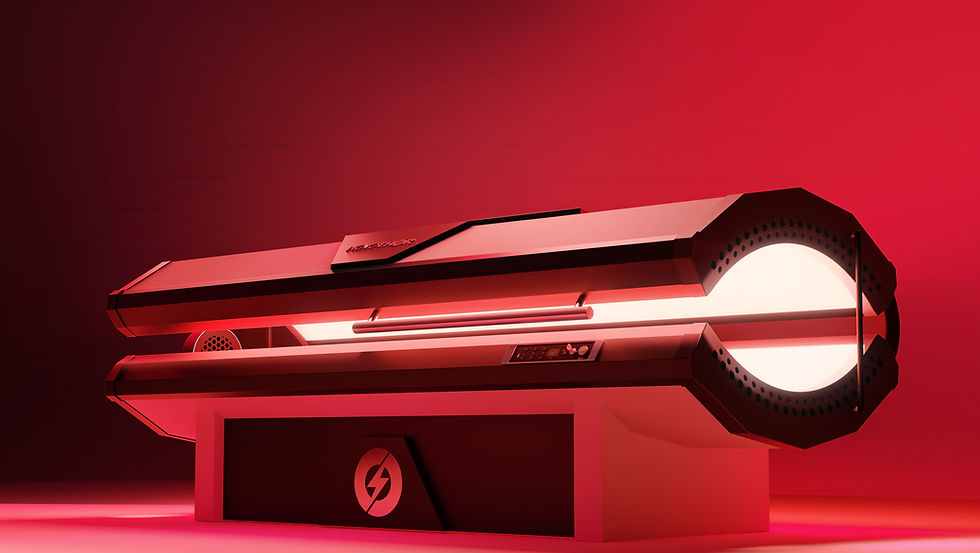
At Lumora Core, our full-body red light therapy sessions in Perth use NovoTHOR.
NovoTHOR surrounds the body with medical-grade LEDs delivering two wavelengths:
660 nm red lightand850 nm near-infrared light
Published research using NovoTHOR has employed these wavelengths for whole-body photobiomodulation.
The enclosed design allows a large proportion of the body to receive light during one session rather than treating individual areas sequentially.
A standard session is short and non-invasive. There are no needles, medications or strenuous physical activity involved.
You simply lie comfortably inside the system while the treatment cycle runs.
Who might consider full-body red light therapy?
People exploring photobiomodulation commonly do so as part of a broader approach to wellbeing and recovery.
Research into PBM has included areas such as:
Musculoskeletal discomfort
Exercise and muscle recovery
Joint pain
Fibromyalgia
Neuropathic pain
Inflammatory processes
Recovery following physical activity
The quality and strength of evidence are not identical for each condition, and individual responses vary.
Persistent, severe or unexplained pain should always be appropriately assessed by a qualified healthcare professional rather than self-treated with red light therapy.
Red light therapy for active people and athletes
Pain doesn't necessarily mean disease.
Training, sport and physically demanding work can leave muscles feeling sore and fatigued.
For this reason, another significant area of PBM research involves exercise performance and recovery.
Whole-body photobiomodulation has been investigated in athletic populations, including research involving competitive athletes using NovoTHOR.
This makes full-body PBM particularly interesting for people who train regularly and are looking for a passive recovery modality to incorporate alongside appropriate sleep, nutrition, mobility and rehabilitation.
What does a session at Lumora Core involve?
Lumora Core is located in Applecross, Perth, and specialises in full-body photobiomodulation.
Sessions are designed to be simple.
You lie inside the NovoTHOR whole-body system while red and near-infrared LEDs expose the body to light. There is no physical exertion involved, and you can return to normal daily activities afterwards.
Because photobiomodulation works through exposure to light rather than heat, the experience is different from a sauna or infrared sauna.
Is red light therapy a treatment for pain?
It is better to think of photobiomodulation as a supportive modality rather than a cure for pain.
Pain can have many causes. New, persistent or worsening pain may require medical or allied-health assessment to identify the underlying problem.
PBM should not delay appropriate investigation or replace treatment recommended by your healthcare professional.
What makes the field interesting is that an expanding body of research is examining how red and near-infrared light may influence cellular function, inflammatory processes, recovery and pain signalling.
The evidence is encouraging enough to warrant continued research — but not strong enough to promise that everyone will experience the same result.
Full-body red light therapy in Perth
If you're looking for red light therapy for recovery or pain in Perth, Lumora Core offers whole-body photobiomodulation using NovoTHOR at our Applecross location.
Our focus is straightforward: provide access to a high-quality whole-body PBM system in a comfortable environment, while keeping our information grounded in the scientific evidence rather than exaggerated wellness claims.
Lumora Core – Full-Body Red Light Therapy, Applecross, Perth
Recovery. Reset. Recharge.
References
Ferreira LMA, et al. Photobiomodulation in chronic pain: a systematic review of randomized clinical trials. Frontiers in Integrative Neuroscience. 2026.
Collazo García CL, et al. Short-Term Effects of Whole-Body Photobiomodulation on Pain, Quality of Life and Psychological Factors in a Population Suffering from Fibromyalgia: A Triple-Blinded Randomised Clinical Trial. 2023.
Oliveira S, et al. Effectiveness of Photobiomodulation in Reducing Pain and Disability in Patients With Knee Osteoarthritis: A Systematic Review With Meta-Analysis. Physical Therapy. 2024.
Cheng K, et al. Mechanisms and Pathways of Pain Photobiomodulation: A Narrative Review. The Journal of Pain. 2021.

Comments